In the final week of August, under sunny skies just miles from the nation’s capital, thousands of organizers, artists, educators, advocates, healthcare leaders, philanthropists, youth leaders, and movement builders gathered for PolicyLink Summit 2026: We Are the Founders.
American Indigenous Democracy: A Call for Interdependence
One of the most thought-provoking conversations of the summit invited participants to reconsider the foundations of democracy itself.
Featuring Indigenous knowledge keepers and leaders including José Barreiro and Katsi Cook, the discussion explored the Haudenosaunee Great Law of Peace, a governance tradition rooted in stewardship, reciprocity, accountability, consensus-building, and responsibility to future generations.
A question posed during the session lingered long after it ended:
“If independence shaped the last 250 years, what could interdependence make of the next 250?”
At its core, the conversation challenged us to think differently about success, leadership, and democracy itself. What happens when decisions are made not for immediate political gain, but for the well-being of the next seven generations? What changes when communities understand themselves as deeply interconnected with one another and with the natural world?
Particularly powerful were the teachings shared by Michelle Schenandoah and Mommabear, who called participants to imagine a future rooted in balance, reciprocity, and collective care. Drawing from Indigenous traditions and seven-generation thinking, they encouraged us to consider leadership not as dominance or control, but as stewardship. Their vision centered values often missing from our institutions today: relationship, responsibility, community, and honoring the wisdom of women and matriarchal traditions.
The conversation was not simply about understanding the past.
It was an invitation to imagine a more sustainable future.
Building a Better We
Few sessions captured the spirit of the summit more clearly than Building a Better We, featuring john a. powell, Director of the Othering & Belonging Institute.
At a time when division often dominates public discourse, powell challenged participants to think differently about belonging and solidarity. Rather than asking how we eliminate our differences, he asked how we build a society large enough to hold them.
His words resonated throughout the week:
“The ultimate superpower for humans is the ability to love.”
And later:
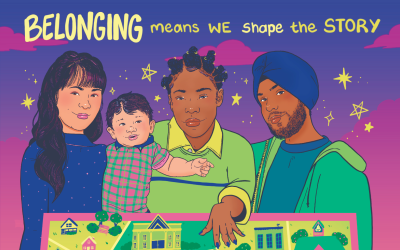
“There are no conditions in belonging. We can disagree, but we all still belong.”
His message was both simple and transformative: belonging is not about agreement. It is about relationship. Democracy is strengthened not when we all think alike, but when we remain connected through our differences and committed to one another’s humanity.
Writing the History of Our Future
This session brought together leaders whose lives embody the ongoing struggle to expand freedom, justice, and belonging.
Michelle Schenandoah, founder of Rematriation and member of the Oneida Nation Wolf Clan, reinforced a theme that surfaced throughout the summit: we must think beyond ourselves. Her reflections challenged us to consider what future generations will inherit from our choices and what wisdom we might recover by listening to Indigenous traditions that have long emphasized stewardship, reciprocity, and balance.
Minnijean Brown-Trickey, a member of the Little Rock Nine, carried living civil rights history into the room. Listening to her speak was a powerful reminder that progress is never inevitable. The freedoms many enjoy today exist because ordinary people found the courage to challenge injustice and demand something better. Her presence reminded us that democracy has always been advanced by people willing to act, even when doing so came at tremendous personal cost.
Karen Korematsu, daughter of civil rights icon Fred Korematsu, reflected on her father’s legacy and the dangers of exclusion and dehumanization. She reminded participants that democracy requires participation and challenged us to move beyond our silos, build bridges across communities, and recognize that protecting the rights of one community ultimately helps protect the rights of us all.
Together, these leaders reminded us that every generation inherits unfinished work.
The question is whether we are willing to carry it forward.
Belonging and the Promise of Democracy
During this powerful conversation, Thu Nguyen, Executive Director of OCA-Asian Pacific American Advocates, spoke about belonging not as an abstract concept, but as something people actively claim.
One statement in particular stayed with many attendees:
“Voting is asserting your belonging to this country.”
The simplicity of the statement was what made it so powerful.
Her words transformed civic participation into something deeper than a democratic responsibility. It became a declaration that our voices matter, our experiences matter, and that each of us has a place in shaping our collective future.
At a time when many communities continue to fight for recognition, representation, and dignity, her remarks served as a powerful reminder that belonging is something we must continually create, protect, and extend to others.
Governing for the Next Generation
Perhaps the most emotional moments of the summit came from PolicyLink’s Youth Founding Fellows and Youth Fellows for All.
These young leaders spoke with clarity, urgency, and hope about the future they want to inherit and the future they are already helping to build.
“Our vision for 2076 is a world where wages are livable, affordable housing is accessible, and voting rights are protected.”
The room grew quiet.
Not because their vision sounded radical.
Because it sounded reasonable.
They were not asking for extraordinary opportunities. They were asking for a future where democracy works, communities thrive, and everyone has the opportunity to belong.
Many of us left that room with a renewed sense of responsibility.
One of the most powerful threads woven throughout the summit was the connection between Indigenous teachings and the voices of young people. The Haudenosaunee Great Law of Peace asks leaders to consider the impact of their decisions on the next seven generations. The Youth Founding Fellows challenged adults in the room to do the same.
Though separated by generations, both carried the same message:
Our responsibility is not only to solve today’s problems. It is to become good ancestors for those who come after us.
What We’re Carrying Forward
As the summit came to a close, music, celebration, conversation, and dancing filled the space. It was a fitting end to a week centered on connection, imagination, and shared purpose.
WE in the World left PolicyLink carrying more than notes and takeaways. We left with renewed relationships, broadened perspectives, and a deeper belief in what becomes possible when people come together across differences in pursuit of a shared future.
The teachings of the week continue to stay with us.
The Indigenous leaders who challenged us to think seven generations ahead.
The civil rights leaders who reminded us that progress has always required courage and collective sacrifice.
The advocates who expanded our understanding of belonging and showed us that participation is an act of claiming our place in the larger story.
And the young people who asked us, with clarity and conviction, to build a future worthy of inheriting.
Together, they offered a vision of democracy rooted not in individual achievement, but in interdependence. Not in extraction, but in stewardship. Not in scarcity, but in the understanding that our futures rise and fall together.
The lesson was both simple and profound:
Leadership is stewardship.
Belonging is a practice.
The future is not something we inherit. It is something we build together.
Thank you to PolicyLink, the speakers, artists, fellows, elders, organizers, and community leaders who created space for truth-telling, imagination, reflection, joy, and action.
The story remains unfinished. Together, we are helping write what comes next.