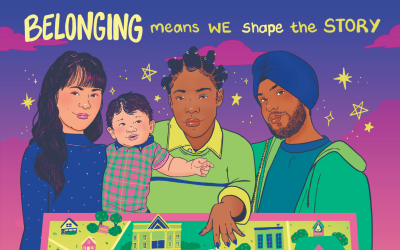
by Mer Young, for Amplifier Art
If we measure the danger to our institutions by the number of disagreements they must manage, then diversity is dangerous.
-Knight Foundation
BEACON for Equity: Toward Power Sharing
Reflecting on power sharing, Charles Darwin’s theory of evolution raises critical questions for me around power dynamics and the formation of social hierarchies. Often misinterpreted and misused, Darwin’s theory has been co-opted to justify human classification and societal inequality. This flawed application of determinism has embedded notions of inequality deep within our psyche, creating systemic issues we are now struggling to dismantle.
As I strive to stay positive about the potential for systemic change, Darwin’s voice echoes in my mind, seemingly advocating for the status quo. In that same breath, I visualize Plato’s hierarchy of classes, rooted in his theory of the tripartite soul, reinforcing these divisive structures. Both thinkers, through their siloed approaches, seem to perpetuate the idea that diversity is inherently divisive rather than a unifying force in human existence.
In their school of thought, we are all victims of nature’s will and not systems and structures. In other words, presumably, privilege and wealth is earned while pain and hardship is deserved. This dichotomy implies that the systemic gaps we experience are subject to nature’s laws and all attempts to go toward a contrary direction might be futile. These theories attribute power to a fraction of the human population, persons of a particular class.
Navigating the deeply ingrained divisive conditioning requires a multifaceted approach that challenges the deterministic views of Darwin and Plato, which have historically been misapplied to justify power imbalances. To move forward, we must challenge these entrenched notions. By recognizing the interconnectedness of all people and valuing diversity as a source of strength, we can begin to create a more equitable and inclusive society. This requires a conscious effort to dismantle hierarchical structures and to cultivate an environment where every individual has the opportunity to thrive, free from the constraints of historical determinism and artificial classifications.
In recent years, we’ve witnessed a profound shift from hierarchical power structures to more horizontal, shared frameworks that emphasize interdependence, interconnectedness, and collaboration. This modern approach is grounded in the principle of equity—that all individuals are inherently equal. With the rise of democracy and the proliferation of information, communities are increasingly informed and engaged in decision-making processes. Those once perceived as indifferent are now actively reclaiming power, demanding inclusion in spaces where decisions that impact their lives are made.
by Marion Olang, WE in the World
Published by WIN DIGEST