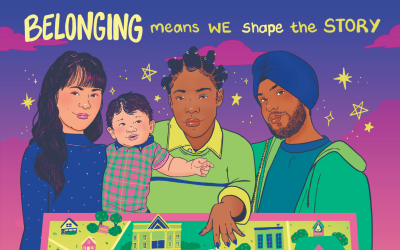
Art by Kate DeCiccio for Amplifier Art
“But one thing is sure and that is the fact that since the fifteenth century these ancestors of mine and their other descendants have had a common history; have suffered a common disaster and have one long memory.” — W.E.B. Du Bois
Legacy and Liberation
By Somava Saha, WE in the World
Over the last year, together with the Institute for Healthcare Improvement and People Power Health, WE in the World supported four convenings designed to help us reflect on what ancestors who have gone before us have to teach us about being better ancestors in this moment.
We learned how John Lewis’s Voter Rights Act not only safeguarded voting rights for Black people, but opened the doors for immigration and created a nation of opportunity. We learned about how Fannie Lou Hamer safeguarded not only the right to vote but built cooperative models to advance economic justice. We reflected on the role of the Black Panthers in reimagining new systems–and how these led to our modern day paramedic systems and school lunch programs.
Black civic leaders taught us–and continue to teach us–how to build a more perfect union with courage and perseverance, how to connect and build solidarity by connecting across movements and vital condition pain points across communities. This issue focuses on the legacy of Black leaders to advancing civic health in the US and around the world–and invites us to consider how Black ancestors and Black history are part of our collective history.
Three Ancestors Who Show Us How to Transform Pain to Power
John Lewis
John Lewis teaches all of us how to build on legacy, to create good trouble when it matters, to persist and endure in the long road to justice. The Voting Rights Act of 1965, considered by many to be the most significant piece of civil rights legislation in recent history, prevented the imposition of limits on voting based on racial discrimination, outlawed literacy tests and other mechanisms enacted by jurisdictions to discriminate against poor and racially marginalized groups, and required bilingual ballots to be provided. It provided a critical check and balance to any proposed measure of state-based discrimination.
Read the full article here.
Check out the latest WE RISE and WIN Together Digest for resources, funding opportunities, and events happening close to you!
Published by WE RISE & WIN Together DIGEST